Freitag, 6. Februar 2026

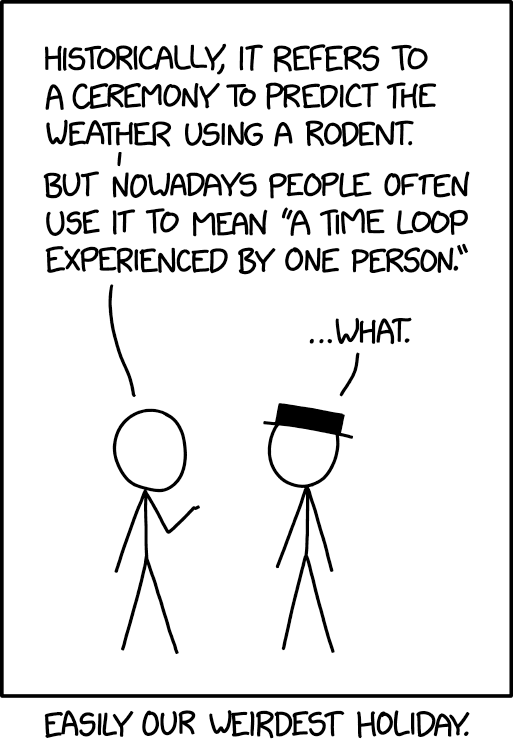
xkcd on "Groundhog Day"

 Putting that here so I can find it if I need to refer to it:
Just a reminder that for establishing an etymology, you often need to know a lot of cultural background. Which we mostly don't have for most of unwritten history. Therefore, we will mostly miss those etymologies that are not based on trivial or widely attested semantic changes.


Dienstag, 10. August 2021

Eastern Wardrobe

The antique wardrobe shown below belongs to a friend. It is supposed to have been produced in Korea. The inscriptions on it look Chinese. Is any of the readers of this blog able to decipher what it means?
Lower part
Upper part.

Update: I posted the question also on the Zompist board. The result of the discussion was that it seems to be a purely decorative use of Chinese signs, some of which even non-existing, that do not form a meaningful text.

Donnerstag, 7. September 2017

Hittite ḫumant- and Vedic ubhau

I put a paper up for discussion on academia.edu.
Abstract:
A connection between Hittite ḫumant- “all, each, entire” and Vedic ubhau “both” was proposed by Puhvel in his Hittite Etymological Dictionary. He analyses ḫumant- as ḫu- + suffix -want- (PIE -went-). For the first element, he assumes an original meaning “both” and for the lexeme a development “both-having” > “all-having” > “all”.
This paper argues that there is indeed a common element *h2u- in both words, but that it's original meaning was "all".
Readers are cordially invited to join over there or to comment here.

Sonntag, 7. Mai 2017

English is the new Latin

Photograph taken in a public park in Tehran in March 2017:


The bird's name is given in three versions - Farsi Tuti touġdār, Scientific Psittacula krameri, and in what is labelled "Latin", but what is clearly English: Rose-ringe parakeet. (And let's just let it slide that there's a typo and the name ought to be written "Rose-ringed parakeet").

Montag, 6. Juni 2016

Arabic the wrong way around

Doing some housekeeping on my notebook, I found this picture I took in a Warsaw Hotel in Summer 2015. As you can see, it's a multilingual sachet with shaving cream. What drew my attention is the Arabic - the wording is correct (جل للحلاقة, jil li-l-ḥala:qati "gel for shaving"), but the writing is left-to-write instead of right-to-left, and it's not a mirror image, but each Arabic letter is printed left-to-right. I don't think that any human being produced that, picking each letter from an Arabic keyboard and putting them in the wrong order; I suppose that this happened when an automatic text editor was used to put all the different language versions into the template for printing, and the automatic editor applied the same text direction to all alphabets indiscriminately. And then, nobody who knows Arabic checked the outcome. But maybe my readers have a better explanation?

Samstag, 7. Mai 2016

"Alles Kokolores"

(Reposting of my Goodreads Review.)
"Alles Kokolores" is a nice little collection of etymologies and word histories of words that are typical for the Rhine / Ruhr area. Debunks folk etymologies and word myths, like the myth that "Fisimatenten" is a loan from French. Written in a chatty, very intelligible style, and it also doesn't shy away from admitting when the etymology of a word simply isn't known.
Additional note: Kokolores is one of the words discussed, it means "nonsense".

Montag, 4. Januar 2016

Note on Liberman's Analytic Dictionary of English Etymology


Shortly before the New Year I finished reading Anatoly Liberman's "An Analytic Dictionary of English Etymology". This is a copy of my "review" at Goodreads - it's actually more a shot note:
The Lemmata in this dictionary are presented as examples for a detailed analytic dictionary of English etymology. This works very well for the examples, as they are about words with disputed or unclear etymologies. But a printed dictionary based on this format, containing all lemmata included in the existing etymological dictionaries of English, would go into tens of thousands of pages, so I'd be surprised if any publisher would embark on such an endeavor. Maybe something like this could be realized as an Internet resource.

It is also interesting to see the history of proposed etymologies. But I doubt it is necessary to include contemporary proposals by crackpots like Makovskij – if stuff like that is included, where to stop?

Even if the dictionary project never comes to pass, the book is valuable as a collection of etymologies on which there is no current consensus or for which Liberman challenges the consensus.

Additional note: Goodreads commenter Chris alerted me to this recent article on Liberman, which I gladly share here.